Cabbage looper
Trichoplusia ni ()
Lepidoptera: Noctuidae
Trichoplusia ni is subtropical in origin, but it is now widely distributed throughout Asia, Europe, and North America.
Why is T. ni difficult to control?
- it is a polyphagus insect
- has developed insecticide resistance
Host plants and damage
This insect is highly polyphagous and can be found on all crucifers, Phaseolus (beans), Solanum tuberosum (potato), Lactuca sativa (lettuce), and Lycopersicon esculentum (tomato).
Cabbage plants can tolerate substantial feeding before heading without yield loss, but feeding on the head or inner leaves significantly causes a reduction in marketable yield.
Plant growth stages affected
T. ni is attacks all host plant growth stages, but is especially serious during the vegetative stage.
Affected plant parts
Larvae feed mainly on host plant leaves.
Symptoms
Cabbage looper larvae damage cabbage through feeding holes in leaves and boring into heads. Young larvae feed primarily on the underside of lower leaves. Older larvae move deeper into the plant, especially under hot, dry conditions, to feed on the heart leaves and heads on cabbage and the heads on cauliflower.
Morphology & biology
Eggs are yellowish white or light greenish in color and laid singly on host plant leaves. Clusters of up to ten eggs are not uncommon. Eggs hatch in about two, three, and five days at 32, 27, and 20 °C temperature.
Young larvae are initially white, but become later pale green. Larvae have a light stripe down each side. They grow to 4 cm in length. The caterpillars move with a characteristic “looping” motion. For this they hold on with the front legs and arching the middle portion of the body to bring the prolegs (hind legs) forward, and then extend the front of the body while holding on with the prolegs.
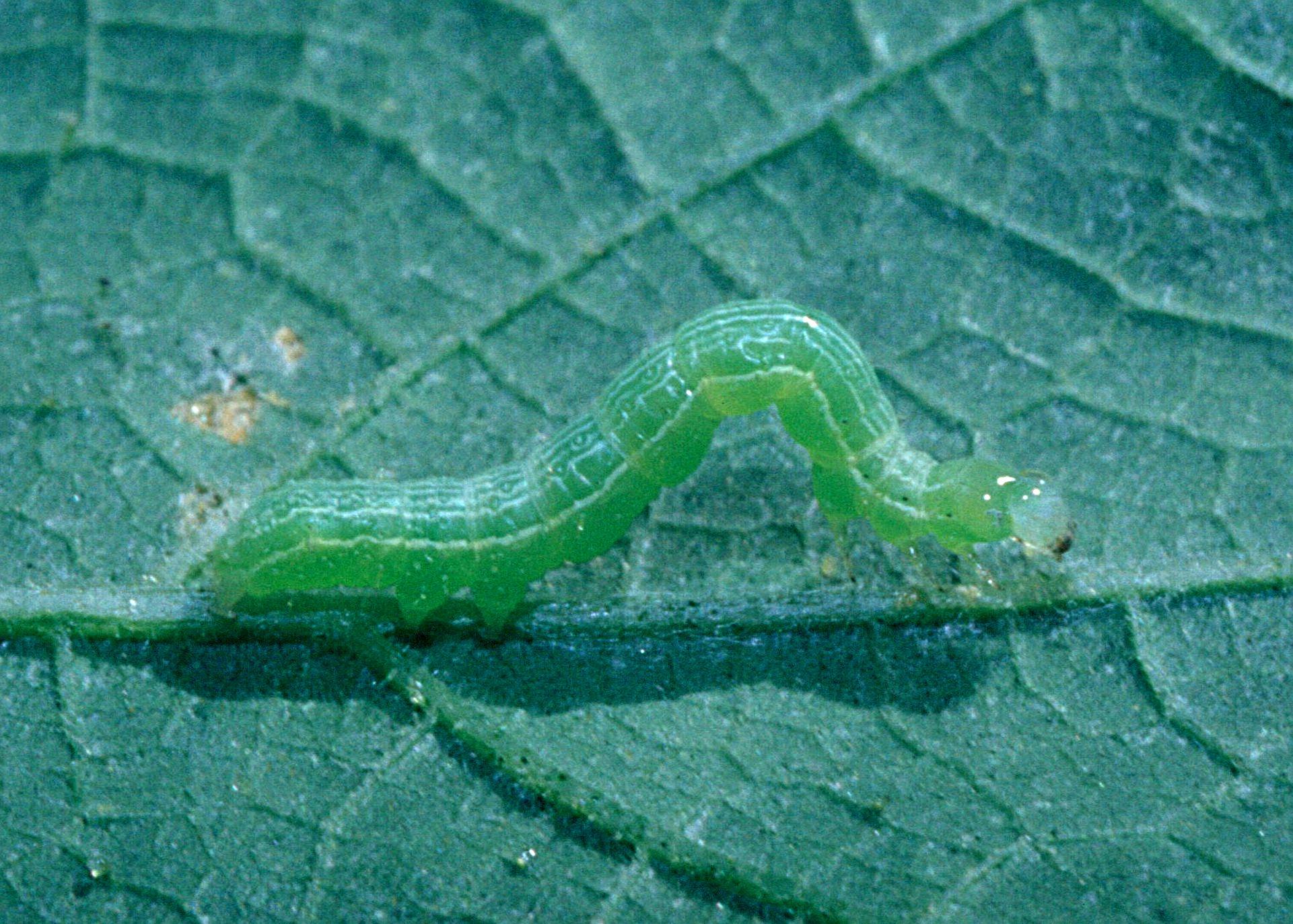
Cabbage looper are easily confused with other loopers, but can be distinguished from most by the presence of small structures (prolegs) located ventrally on the 3rd and 4th abdominal segments. The Soybean looper, Pseudoplusia includens (Walker), also has these structures, but usually dark thoracic legs.
Pupation occurs in a cocoon, about 2 cm in length, attached by one side to a plant leaf. The pupae is initially green but turns dark brown or black. The duration of the pupal stage is 13 days at 20 °C.
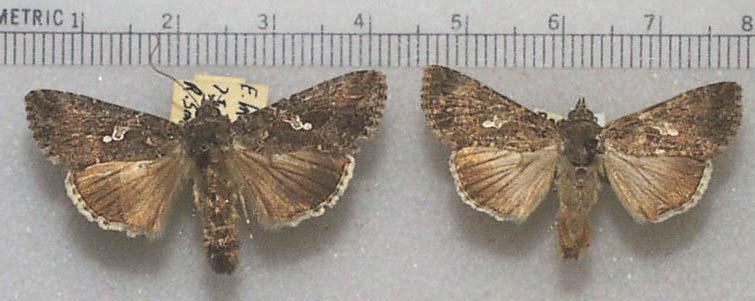
Adult cabbage loopers are nocturnal. They are 2.5 cm long and gray-brown. The moths have a wingspan of 33 to 38 mm. On the forewing are silvery white spots. The forewing spots serve to distinguish cabbage looper from most other crop-feeding noctuid moths.
Monitoring
Search seedlings on both sides of the leaves for caterpillars. Inspect heads of cabbage for chewing holes and internal boring damage.
Blacklight traps and pheromone traps can be used to predict looper population densities.
Pest management
Biological control
Trichogramma spp. are the major parasites of cabbage looper eggs. Supplemental releases of Trichogramma sp. have shown in the US potential for suppressing cabbage loopers on cruciferous crops. There are several species and strains of Trichogramma, which vary considerably in their ability to control the cabbage looper and in their adaptation to different environmental conditions and crops, but the differences are not well understood.
Twenty species of pathogens are described to attack the cabbage looper, although most are not effective in regulating populations of this insect in the field. Cabbage looper populations can be infected naturally with NPV disease, but generally only after the pest has reached damaging levels. Virus infected loopers turn a chalky white and appear half-dead.
Bacillus thuringiensis can provide good control of the cabbage looper on cabbage if applications are made when larvae are small. Pheromone traps can be used to monitor adult flight and plants can be scouted for eggs to determine the best timing of Bt applications.
Cultural control
Removal of caterpillars by hand-picking to prevent feeding damage may be practical only in a small home garden. Inspect plants thoroughly and frequently to eliminate newly hatched caterpillars or those that may have escaped earlier detection.
Chemical Control
Several synthetic insecticides can be used to control the cabbage looper. Apply insecticides soon as infestation is observed. Pheromone traps are available to monitor populations in the field.
Insecticide resistance has become a problem in cabbage looper control, but susceptibility varies widely among locations.