Cabbage flea beetle
Phyllotreta striolata ()
Coleoptera: Chrysomelidae
The cabbage flea beetle, also known as striped flea beetle is widespread in Europe and Asia. This species is recently introduced in South Africa and North America.
Why is P. striolata difficult to control?
- it is very small and difficult to detect
- Larvae feed protected from direct contact with insecticides on the roots
- has developed resistance to some insecticides
Host plants and damage
Primary hosts are cruciferous plants like Brassica campestris ssp. chinensis (pak-choi), Brassica oleracea var. capitata (cabbage), and Raphanus sativus (radish). Adults chew small round holes in leaves. The seedlings may be killed if damage is severe. Damage through larval feeding to the roots is less apparent.
Morphology & biology
Eggs are oval in shape and often are laid singly, but more frequently in groups. They are oviposited in the soil or plant base. Their color is creamy-white or yellowish-white immediately after oviposition but changes to white and then to transparent.
Larvae are fleshy, almost cylindrical, and white, with an indistinct pale brownish tinge on the thorax and abdomen. They feed on roots and stems.
Pupation takes place in a 3 mm long cocoon in the soil.
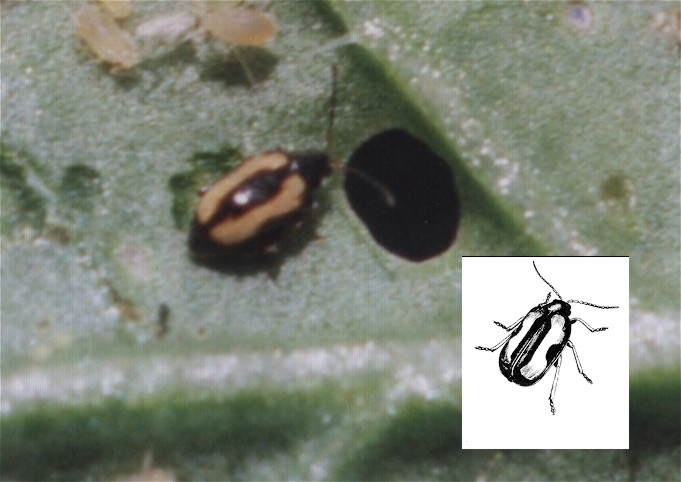
Adults are shiny black. Elytra have characteristic yellow stripes distinctly narrowed in the middle. Antennae differ in the male and female. The fifth segment of male antennae is distinctly thickened. Base of the tibia is yellowish brown and tarsal segments are brown. The body length is about 2.2 mm.
Monitoring
Leaves heavily infested with cabbage flea beetles appear burnt, and the loss of seedlings in nurseries can be considerable.
Field infestations of cabbage flea beetles can be identified by surveying crops for shot-holes in leaves caused by adults. Plants may be pulled and their roots examined for the elongate, white larvae. Soil surrounding plant roots may be also examined for present of pre-pupae and pupae.
Pest management
Biological control
The parasitoid Townesilitus psylliodis (Loan) was released 1978-1983 in Canada to reduce Phyllotreta populations infesting canola (Brassica napus var. napus). No evidence of establishment was found two years after the last release.
In China the release of the nematode Steinernema carpocapsae agriotis resulted in a 38-84% population reduction of cabbage flea beetles.
Cultural control
In experiments it was shown that population densities on unfertilized plants were higher than on plants receiving nutrients. Densities were also higher on plants treated with composted manure than with fresh manure.
Chemical Control
The use of synthetic insecticides is the most common way to control this pest, although insecticide resistance to DDT, aldrin, dieldrin and lindane is reported. Only adults can be targeted for pest control because larvae are well protected in the soil.
Recommendations for better management:
- apply insecticides only if infestation is severe
- vigor, healthy plants are less affected by cabbage flea beetle feeding, therefore ensure sufficient water and nutrient supply for the plants