Soybean webworm
Omiodes indicata ()
Lepidoptera: Pyralidae
The species is partial distributed in the tropics and subtropics throughout the world.
Why is soybean webworm difficult to control?
- larvae web leaves together and live protected from direct contact with insecticides between them
Host plants and damage
Soybean webworm larvae are polyphagous with a preference for leguminous plants. Important host plants are Vinga unguiculata (cowpea), Glycine max (soybean), Phaseolus (beans), and Cajanus cajan (pigeon pea).
Larvae feed on leaves and web them together. Webbed leaves and defoliation are typical signs for soybean webworm larvae.
Morphology & biology
Adult females lay 300 to 400 eggs on host plant leaves or shoots. After 4-7 days first instars hatch. The larvae web leaves together and lives usually between them. They are bright green and very active when disturbed.
Pupation takes place between leaves spun together.
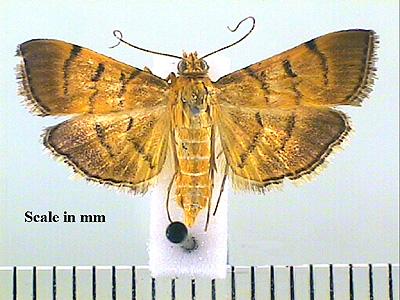
The adult life span is 4-14 days. The moths are variable in color but usually red-brown with some lighter gray markings. The wingspan is 20-28 mm. Because of the variation in color identification is best by dissecting the genitalia. Male genitalia are covered dorsal with short spines.
Monitoring
Monitor for leaves fold together. Larvae and pupae are between these leaves. When larvae are disturbed they become very active.
The number of leave folds per plant can be used to measure infestation.
Pest management
Biological control
Several parasitoids including Trichogramma ssp., Apanteles ssp., and Chelonus sp. are reported for soybean webworm.
Cultural control
Some soybean cultivars have been reported as less susceptible than others but none as resistant.
Chemical Control
Several systemic and contact insecticides are reported as effective against soybean webworm.
Recommendations for better management:
- choose less susceptible crop varieties