Tomato fruitworm
Helicoverpa armigera ()
Lepidoptera: Noctuidae
The tomato fruitworm is distributed throughout the tropics and subtropics except in the American. The old name for this species, Heliothis armigera, is well established in the literature
Why is tomato fruitworm difficult to control?
- it is a polyphagous pest
- pupae can overwinter in the soil
- high reproduction rate
- adults are highly mobile
Host plants and damage
Tomato fruitworm is a polyphagus pest and considered one of the major pests of fiber plants. Primary host plants are: Glycine max (soyabean), Phaseolus (beans), Allium (onion, garlic, etc), Crucifers (pak-choi, mustard, cabbage, etc), and Lycopersicon esculentum (tomato).
Tomato fruitworm feed on flowers, pods/seeds and fruits. The damage symptoms differ by host species. On tomatoes young fruits are infested and fall. Large larvae may bore into older fruits. Secondary infections by other organisms may lead to rotting. On pigeon pea young larvae bore into flowers and buds. Older larvae bore into pods and consume the developing seed
Morphology & biology
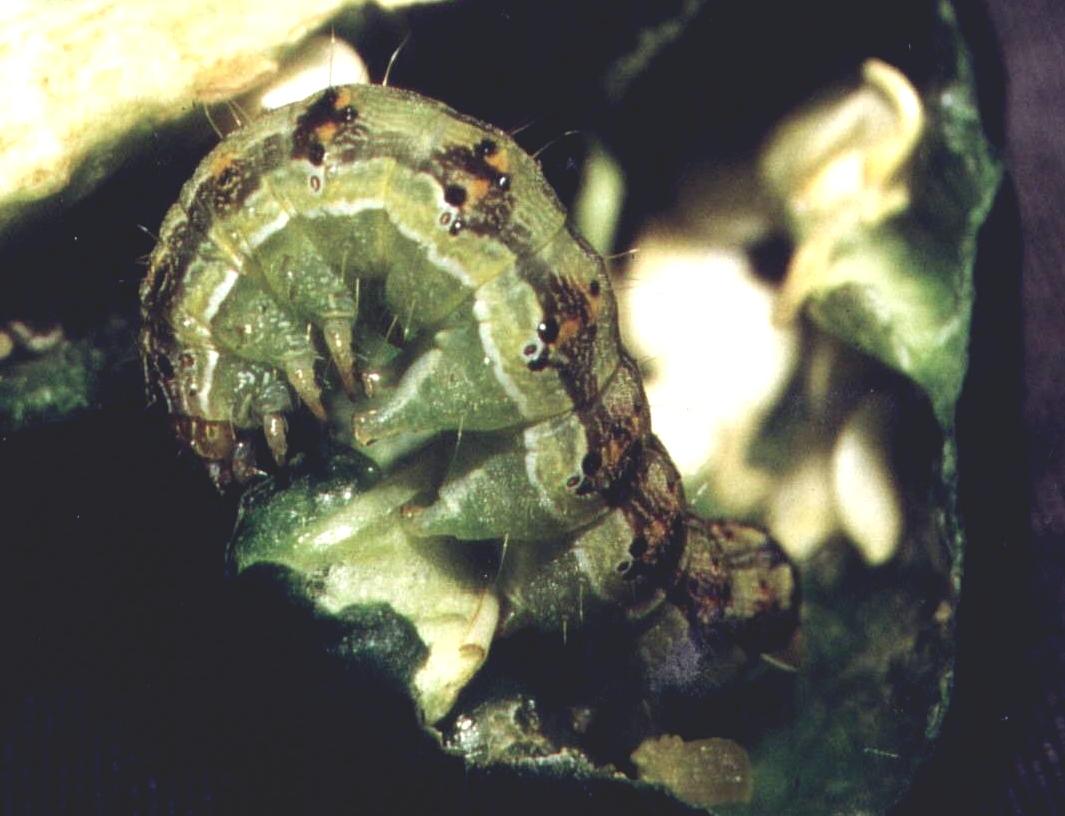
Eggs are yellow-white in color and change to dark-brown before hatching. Eggs are 0.4-0.6 mm in length. The area surrounding the micropyle is smooth; the rest of the surface shows longitudinal ribs. Eggs are laid singly on leaf surfaces, buds, and flowers.
Larvae hatch a 25ºC in 3 days, but hatching may require up to 11 days at colder temperatures. The duration of larval development depends on temperature, and on the quality of nourishment. First and second instars are yellow-white in color with legs brown to black like the base of the spiracles, given the larvae a spotted appearance. Tomato fruitworm passes through 5-6 larval instars. The color is extremely variable, especially in older larvae.
Last instar larvae pupate in the soil. Pupae can overwinter in the soil if necessary. Pupae are 14-20 mm long and mahogany-brown in color.
Adults have a wingspan of 35 to 40 mm. Their length is 14-18 mm. Color is variable, but males are usually green-grey and females orange-brown. Oviposition can take up to 25 days with a total of 1600 eggs per female. Adults are inactive during the day, resting between the foliage. Adult longevity is up to two three weeks.
Monitoring
Young feeding larvae can be found on plant surfaces. Older larvae are often hidden in plant organs (flowers, fruits, pods etc). It is necessary to cut and open plant organs to find larvae.
Pest management
Biological control
The relative importance of parasitoids and predators varies between localities and crops.
Intermediate rates of parasitism have been recorded for some Tachinidae, but these generally occur too late in the larval stage to reduce host damage.
Nematodes, usually Mermithidae, are often recorded as parasitoids. However, high rates of parasitism occur only sporadically when conditions are favorable.
There has been some success in the use of pathogens, Bacillus thuringiensis and Helicoverpa armigera nuclear polyhedrosis virus (HaNPV) preparations, applied like insecticides to manage larval populations in the laboratory. Field tests have had only limited success because of rapid degredation by UV light. Also some strains of tomato fruitworm became resistant to Bt.
Cultural control
Planting of resistant or tolerant varieties is important in many IPM-systems. Varieties of groundnut and pigeon pea with different degrees of resistance have been developed in India, and used successfully by farmers.
Trap cropping has been widely used and recommended in the past, but recent studies showed only a limited effect.
Removal of damaged fruits can reduce insecticide application frequency.
Chemical Control
Most insecticide applications are targeted at larval stages. Older larvae are often hidden in plant organs and therefore doses required to kill the insect may be higher.
Resistance to pyrethroids has been reported. If insecticide applied is ineffective use alternating insecticides from a different chemical group to minimize selection for resistance.
Recommendations for better management:
- monitor your field closely for first and second instar larvae and apply insecticides early
- apply effective insecticides, if insecticide used is ineffective apply another insecticide from a different chemical group
- remove damaged fruits