Green semi looper
Chrysodeixis eriosoma ()
Lepidoptera: Noctuidae
The green semi looper occurs throughout the tropical and subtropical regions of eastern Asia and the Pacific islands as well as Australia and New Zealand.
Why is the green semi looper difficult to control?
- it is a polyphagous pest
Host plants and damage
Green semi loopers feed on leaves and fruits of many crops and weeds. Primary hosts are: Lycopersicon esculentum (tomato), Phaseolus (beans), Solanum tuberosum (white potato), Glycine max (soybean), Brassica oleracea (cauliflower), Cynara scolymus (artichokes), and Medicago sativa (Lucerne).
Young larvae feed on leave undersides making windows between the veins. Older larvae chew holes through the leaves. On tomato, larvae can chew into the fruits. The adults feed on nectar and are not pests.
Morphology & biology
Eggs are pale green with vertical ribs. They are laid single or in small clusters. Each female can lay a total of up to 300 eggs during her lifespan.
First instars hatch after 5-7 days. They are green and covered with black body hairs (setae). Larvae are about 20 mm long and grey-green in color with yellowish heads. There are usually 6 larval stages. Color can varies depending from diet. Larvae drop from leaves when disturbed, hanging on a silken thread. Larvae appear to have only two prolegs but have actually three.
Pupae are green-brown in color. Pupation takes place in a silken cocoon on undersides of leaves or other suitable substrates. Duration of pupal stage is 8-11 days.
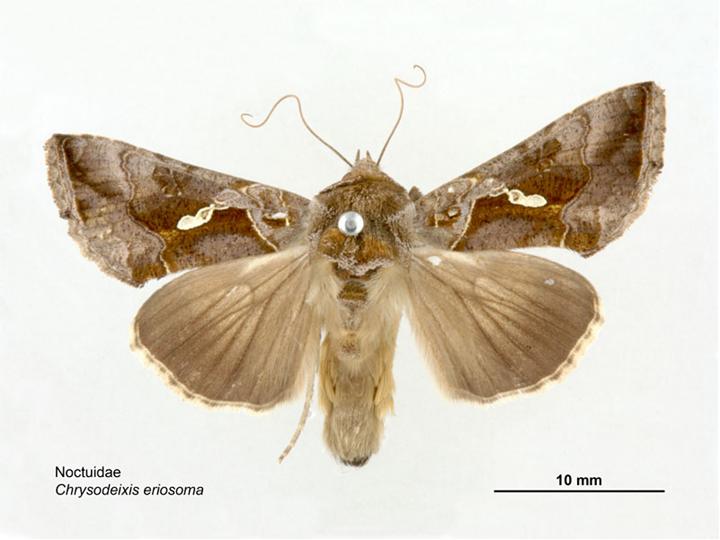
Adults have a wingspan of 20-22 mm. The wings have a bronze-white-golden color. On the forewings are two silvery white spots (stigma) near the center. Hindwings are yellow gray in color. The body color is light brown or yellow. On the last abdominal segment are hair tufts for both sexes.
C. eriosoma is closely related to the Palearctic species C. chalcites which occurs in several European countries. The relationship between these two pest still needs to be clarified.
Monitoring
Look in the field for feedings windows. You find larvae and pupae on the undersides of the leaves.
Pest management
Biological control
In Hawaii are several parasitoids present contributing to control C. eriosoma populations. These parasitoids include Copidosoma truncatellum and Eucelatoria armigera.
Cultural control
In Hawaii Indian mustard (Brassica juncea) showed potential for use as a trap crop for the green semi looper.
Chemical Control
Several contact insecticides are recommended to control green semi loopers.
The anti-feedant neem has been tested successfully to reduce green semi looper populations in cabbage.