Cotton aphid
Aphis gossypii ()
Sternorrhyncha: Aphididae
The cotton aphid is completely cosmopolitan and occurs in all tropical and most temperate regions worldwide. In some countries such as Thailand, Philippines, China, and Fiji it is the most common and destructive aphid species in vegetables. Worldwide are several biotypes of the cotton aphid described.
Why is the cotton aphid difficult to control?
- it has a very short life cycle and high reproduction rate
- it vectors viruses
- it is resistant against many insecticides
Host plants and damage
Cotton aphids are widely polyphagous. The host range includes over 92 plant families, including crops, ornamentals, and flowers. Primary vegetable host plants are Cucurbita moschata (pumpkin), Cucumis melo (melon), Cucumis sativus (cucumber), Cucurbita maxima (giant pumpkin), Asparagus officinalis (asparagus), Piper nigrum (pepper), Solanum melongena (eggplant), and Abelmoschus esculentus (okra). In many parts of the world it is a major pest on citrus. In Central and South America it also damages coffee and cocoa.
Damage is done through feeding and virus transmission. Cotton aphid can transmit more than 35 different viruses. For cucurbits this would include cucumber mosaic virus, watermelon mosaic virus, and zucchini yellow mosaic virus. For many crops virus transmission is more important than direct damage.
Initial symptoms of an attack are yellowing of the leaves. As infestation becomes severe, leaves become curled and plants stunted.
Adults secrete honeydew, which provides a substrate for growth of sooty mold.
Morphology & biology
Cotton aphid reproduction is mostly asexual in Europe, they reproduce parthenogenetically (viviparously). However, in USA, China, and Japan there is sexual reproduction. The optimal temperature is 20-25 °C for reproduction. Minimum temperature for development is 5 °C and maximum 35 °C. Each female can produce up to 3 offspring’s per day.
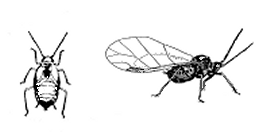
The color from cotton aphids can range from yellow to very dark green. Host plant can influence body color. They are 1-2 mm in length and have a diameter below 0.5 mm. First instar nymphs have 4 antennal segments, while second instars have 5 segments.
Cotton aphids are usually wingless until high population densities are reached. The wingless parthogenetic females are variable in color have pale legs and black tarsi. The cornicles are also black. Winged parthogenetic females have a black head and thorax. The wing veins are brown.
Taxonomically is A. gossypii difficult to separate from A. spiraecola, the spirea aphid, but taxonomic keys are available.
Monitoring
Look for sticky surfaces, which indicate aphid feeding on the foliage.
Cotton aphids are often associated with ants. Look for the presence of ants. This is not specific for A. gossypii but is typical for aphids.
Pest management
Biological control
Few natural enemies of aphids are hosts specific. There are only two groups of hymenopterous parasitoids restricted to aphids, one consisting of species in the family Aphidiidae, the other containing species belonging to the family Aphelinidae. The important natural enemies are varying according to the crop. The wasp Lysiphlebus testaceipes (Cress) is described as effective in controlling cotton aphids.
The effectiveness of predators is highly variable. Many predators such as Coccinelidae may only lay their eggs in the presence of sufficient aphids.
The most important pathogens attacking cotton aphids are fungi. All life stages are attacked.
Cultural control
Intercropping potatoes with onion is reported to reduce cotton aphid populations. Avoid over-fertilizing with nitrogen.
Some level of resistances is reported for different crops.
Chemical Control
Many synthetic insecticides have been reported to be effective against A. gossypii. However insecticide resistances against many synthetic insecticides out of different classes, particularly organophosphates are widespread. Reported are several mechanisms for resistance: enzymatic differences, and modifications to the cuticle. Therefore insecticides should be used in conjunction with non-chemical control methods to decrease the probability of resistances.
Recommendations for better management:
- check effectiveness of different insecticides, if materials applied are not effective, change group of materials