Black cutworm
Agrotis ipsilon
Lepidoptera: Noctuidae
The black cutworm occurs often on wet soils or on recently flooded grounds. For this reason this species has been known in some areas as overflow worm. Black cutworms are worldwide distributed.
Why is black cutworm difficult to control?
- it is a highly polyphagous pest
- older larvae hide in the soil
- females can lay as many as 2000 eggs
Host plants and damage
Black cutworm has a very wide host range. Attacked crops of economic importance are: Phaseolus (beans), Brassica oleracea var. botrytis (broccoli), Brassica chinensis (cabbage), Daucus carota (carrot), Vigna unguiculata (cowpea), Lactuca sativa (lettuce), Cucumis melo (melon), Solanum tuberosum (potato), Spinacia oleracea (spinach), Lycopersicon esculentum (tomato), and others.
Especially seedlings are susceptible to Black cutworm damage. Black cutworms typically cut off seedlings or young plants just below ground level. They feed on leaves, stems, fruits and pods.
Early instars can create “shotholes” while feeding on the leaves. Older larvae feed commonly on seedlings at ground level. They cut off the stem and drag sometimes the plant in their burrows. On occasion larvae feed on the roots of their host plants.
Morphology & biology
Adult females lay up to 2000 eggs singly clustered on leaves or stems close to the soil.
Eggs are creamy white with a ribbed surface. They hatch in 3-6 days and young larvae feed on leaf surfaces. Third instars and older larvae avoid daylight and hide in the soil. They feed only during nighttime. When disturbed larvae tend to curl up into a C-shape. They are dark brown to black in color with faint light stripes running laterally on each side of the body. The head is dark brown with two white spots. There are six or seven instars, depending on temperature and diet.
Pupation takes place in the soil and is completed after 10-20 days. Pupae are 17-25 mm in length.
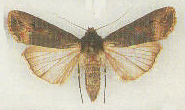
Adults are usually brown or gray with irregular spots and lighter hind wings. The forewings are gray with dark brownish or black markings. The hindwings are almost white and the body gray in color. Wingspread is approximately 35-50 mm. Male antennae are feathered, while female antennae are filiform.
The life-cycle from egg to adult is completed in 32-67 days depending on the temperature. In colder regions the larvae can overwinter and pupate in spring.
Monitoring
After crop emergence monitor for black cutworm damage on seedlings. Damage is often more serious on the field edges. Larvae are best found at dawn or at night. Pheromone traps can be used to monitor population densities. Bait traps including wheat seedlings, wheat bran, in a green cylinder have been developed in Missouri (USA) and successfully used for monitoring.
Pest management
Biological control
Several parasitoids are reported attacking black cutworms. The most important parasite in Pakistan is Cotesia ruficrus Haliday.
Biological insecticides such as Bacillus thuringiensis, nuclear polyhedrosis virus, and nematodes have been successfully tested for biological control of black cutworm.
Cultural control
Eliminate weeds from field margins and plow fields at least 2 weeks before planting. Destroy plant residues from previous crops.
Chemical Control
Because larvae are protected from direct contact it is necessary to apply high doses of insecticides. Applications should be timed that they hit feeding larvae on the plant leaves or soil surfaces. Apply granular insecticides directly to the soil.
Recommendations for better management:
- Eliminate weeds and plow field before planting
- Destroy plant residues from previous crops
- Use bait traps to assess cutworm populations