Wireworms
Agriotes lineatus () and A. obscurus ()
Coleoptera: Elateridae
The two European wireworms are considered major pests in Europe and western Asia. They have been introduced in 1950 in Canada and are found the first time 1997 in the US. Wireworms are the larval stage of click beetles.
Why are wireworms difficult to control?
- larvae, wireworms, live up to 6 years hidden in the soil, damaging on roots
- a single larva can destroy several plants
- they are extremely polyphagous
Host plants and damage
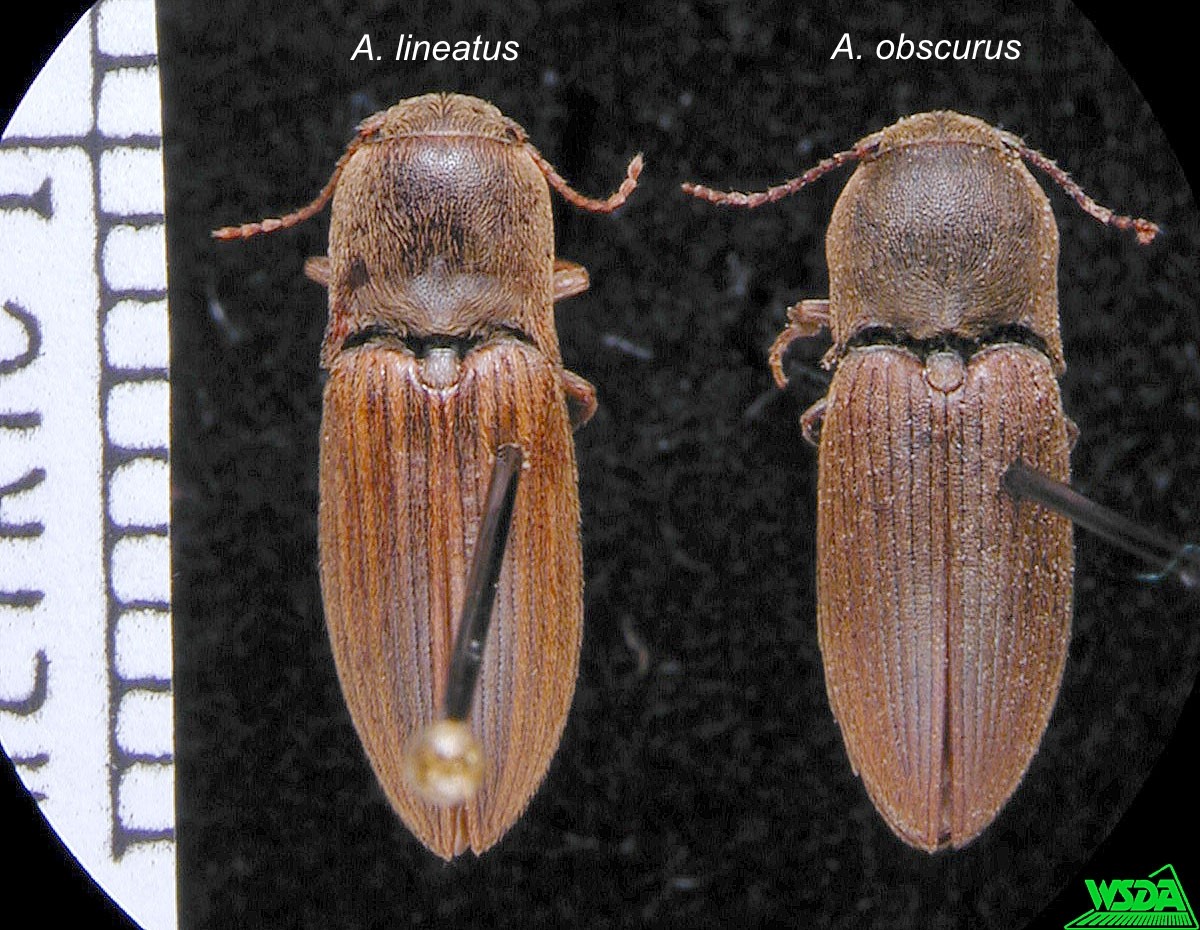
Wireworms are extremely polyphagous and feed on numerous plant species, especially in regions with a humid climate. They locate seeds by detecting the carbon dioxide produced during germination. Primary host plants are Legumes, Solanum tuberosum (white potato), Zea mays (maize), Pocacea (grasses), Daucus carota (carrot), Lycopersicon esculentum (tomato), Allium cepa (onion), and Lactuca sativa (lettuce).
They are feeding on plant roots and other organic material. Adults feed on nectar from flowers and on leaves and are not pests.
Plants are wilting if infestation is severe. Plant roots are visible damaged by wireworm feeding.
Morphology & biology
Females deposit their eggs in 2-6 cm depth, singly or in clusters of 5-15. They can lay a total of up to 200 eggs.
First instars hatch after 25-60 days. Wireworms are 17-20 mm long and have a shiny pale yellow color. The larvae are very sensitive to drought, moving vertically in the ground, depending from the humidity.
Larvae pupate in a few centimeter depths. Pupation takes 3-5 weeks.
Adults are flattened, elongate, brown or black beetles and 7-8 mm in length. The large head is almost hidden by the thorax.
When A. lineatus is turned on its back it cannot right itself by rolling on its short legs. On the underside adults have a click mechanism to aid turning around. They release this mechanism with an audible “click” which causes the head to snap back with such force that they can be propelled into the air as much as several centimeters. The same mechanism is used for defense when predators pick them up.
Adults can overwinter in the ground if conditions are not favorable.
Monitoring
Remove dead plants and look for wireworms on and in the roots.
In 2000 first experiments were done using pheromone traps for monitoring, developed in Canada. The trap is designed to capture adult click beetles.
Pest management
Wireworms are often widespread in grasslands and become a problem when these areas brought into cultivation. Often they disappear after one life-cycle of 5-6 years.
Cultural control
Trap crops of wheat, for example, could be planted in advance to other susceptible crops.
Chemical Control
Several contact insecticides are effective to control Wireworms. In some studies granular insecticides were effective when brought to the surface at harvest where larvae would be exposed.