Search by damage key [→ Leaf damage, Holes in leaves]

PictureScientific nameCommon nameDescription
Agrotis ipsilonBlack cutwormLarvae hide during daytime in the soil. Young larvae feed on leaves, older larvae feed commonly on seedlings at ground level, sometimes cutting off the stem. When disturbed larvae curl up into a C-shape. They are dark brown or black in color. Adults are brown or gray with irregular spots and lighter hind wings.
Agrotis segetumTurnip mothLarvae are covered with long hairs and 1st instars have 3, 2nd instars between 6 and 10 prolegs. Fully grown larvae are 40-50 in length. Adults have a wingspan of approx. 40 mm and brown fore wings with a clear circular spot in the middle.
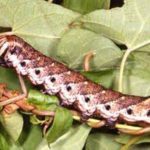
Agrius convolvuliSweetpotato hawkmothThe night-active larvae prefer younger leaves to feed. Larval color is variable but green is dominant. Pupae are 40-70 mm long, mahagony brown in color and have distinctive "jug-handle" proboscis. Adults have a wingspan of 80-130 mm. Ground color is light to dark gray with dark patches and markings.
- no photo available -Crocidolomia pavonanaCabbage caterpillarYoung larvae feed on undersides of leaves, older larvae skeletonize complete leaves. Larvae are green-yellow in color, head and thorax are dark brown. Late instars are characterized by white longitudinal stripes. All abdominal segments have tubercles.
- no photo available -Chrysodeixis eriosomaGreen semi looperYoung larvae feed on leave undersides making windows between the veins. Larval color varies depending from diet. They appear to have only 2 but have actually 3 prolegs. Adults have a bronze-white wings with two silvery white spots near the center of the forewings.
- no photo available -Diaphania hyalinataMelonwormLarvae have white stripes on the length of the body. Adult moths have black wing margins with lighter, pearly-white areas. Wingspan is about 25 mm.
- no photo available -Diaphania indicaCucumber mothThe cucumber moth can be distinguished from the melonworm by the absence of an extension for the brown marking on the forewing. First instars are transparent but change to green. Fully grown larvae are up to 25 mm in length. Adult moth have transparent white wings with a brown band around the edge.
Pieris rapaeImported cabbage wormYoung larvae are pale yellow and covered with fine hair. Later instars become green. Larvae silk the surface of host plant leaves and anchor their rear ends to it. The adults have white wings with black spots.
- no photo available -Spodoptera exiguaBeet armywormYoung larvae commonly feed on the under surface of leaves, leaving the upper epidermis and larger veins intact. They are light green to dark brown with longitudinal stripes. Adults are 10-15 mm long with a wingspan of 25 mm.
Spodoptera lituraArmywormEggs are laid in clusters of several hundred. Larvae are hairless and variable in color. They have longitudinal bands and two dark spots laterally on each segment.
Trichoplusia niCabbage looperYoung larvae are initially white, but become later pale green. They have a light stripe down each side. They grow 4 cm in length. The caterpillar moves with a characteristic "looping" motion. Adults are 25 mm long, gray-brown with a wingspan of 33 to 38 mm.
- no photo available -Omiodes diemenalisSoybean leaf folderLarvae are about grayish green with yellowish heads. They feed on host plant leaves. Adults are light brown in color with yellow patches.
Omiodes indicataSoybean webwormLeaves webbed together and defoliation are typical signs of infection. The larvae are bright green and very active when disturbed. Adults are variable in color but usually red-brown with some lighter gray markings.
Phyllotreta striolataCabbage flea beetleLarvae are hidden, they feed on roots and organic matter in the soil. Adults are shiny black with characteristic yellow stripes on the elytra. The body length is about 2.2 mm. Adults chew small, round holes in leaves.
PictureScientific nameCommon nameDescription